


 India +91 88700 80126
  UAE +971 54 598 5547
 What Is Hydrogen-Rich Water? Understanding the Science Behind Dissolved Molecular Hydrogen

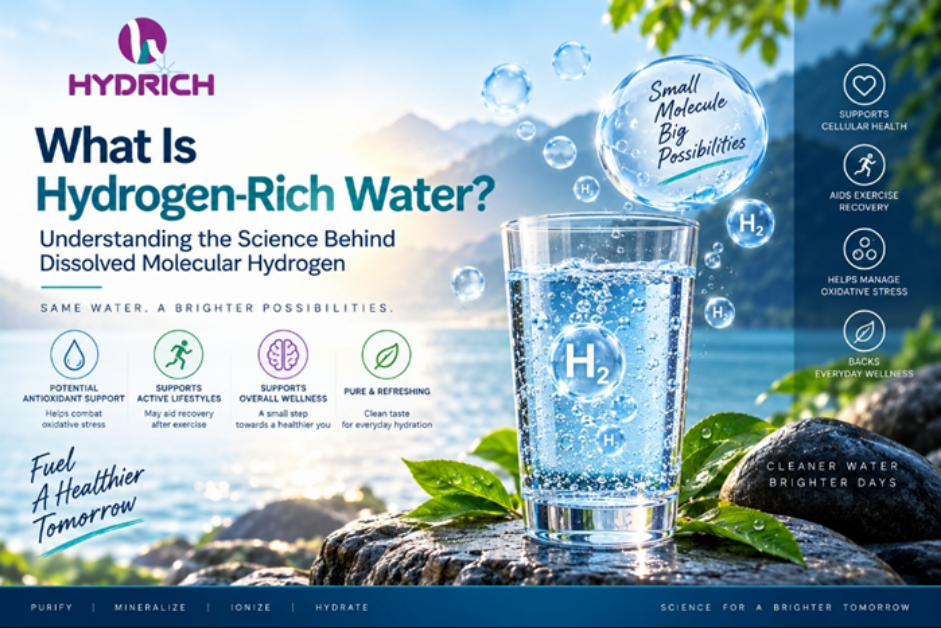
What Is Hydrogen-Rich Water? Understanding the Science Behind Dissolved Molecular Hydrogen
It looks like ordinary water. It tastes like water. So what makes hydrogen-rich water different?
The answer lies in something you cannot see — dissolved molecular hydrogen (H₂).
As people become more conscious about hydration, the conversation is gradually moving beyond simply asking, “How much water should I drink?”
Today, consumers are also asking:
What is actually in my water? How is it treated? What minerals does it contain? And can water offer characteristics beyond basic hydration?
One area receiving increasing scientific and wellness interest is hydrogen-rich water.
At Hydrich, we believe understanding the science behind water is just as important as drinking it.
First, What Exactly Is Hydrogen-Rich Water?
We all know the chemical formula for water:
H₂O
But the hydrogen in hydrogen-rich water is something different.
Hydrogen-rich water contains additional molecular hydrogen (H₂) gas dissolved in the water.
Think of it this way:
H₂O = the water molecule itself
H₂ = molecular hydrogen dissolved within the water
The dissolved H₂ does not turn water into a completely different substance. Instead, molecular hydrogen exists temporarily within the water as a dissolved gas.
This simple distinction is important because molecular hydrogen is increasingly being investigated for its potential biological effects.
Why Are Scientists Interested in Molecular Hydrogen?
Hydrogen is the smallest and lightest molecule.
Over recent years, researchers around the world have studied molecular hydrogen across different areas of health and physiology.
A major area of interest is its possible relationship with oxidative stress.
Our bodies naturally produce reactive molecules during normal processes such as metabolism, physical activity and immune responses.
At normal levels, these processes are part of healthy biological function. However, when the balance between reactive species and the body's antioxidant defence mechanisms becomes disrupted, it is referred to as oxidative stress.
Research into molecular hydrogen has explored whether H₂ may interact with some of these biological pathways.
This has led to growing scientific interest in hydrogen-rich water as a potential form of functional hydration.
Hydrogen Water & Antioxidant Research
The word “antioxidant” is commonly associated with fruits, vegetables, vitamins and other nutrients.
Molecular hydrogen is different.
Rather than thinking of hydrogen-rich water as simply another antioxidant beverage, researchers are studying how molecular hydrogen may interact with oxidative and cellular signalling processes.
This is an important distinction.
Hydrogen-rich water should not be marketed as a miracle cure or medicine. Scientific evidence continues to develop, and results can vary depending on hydrogen concentration, study design, individual health conditions and other factors.
What makes it interesting is the growing body of research exploring its potential.
Hydrogen-Rich Water and Physical Activity
One particularly interesting field of research is exercise and recovery.
Intense physical activity naturally increases metabolic activity and can temporarily increase oxidative stress.
Because of this, researchers have investigated hydrogen-rich water in relation to areas such as:
- Exercise-induced oxidative stress
- Muscle fatigue
- Recovery after physical activity
- Inflammation-related markers
- Athletic performance and endurance
Some studies have reported promising observations, while others show more limited effects.
This means more high-quality research is needed before strong conclusions can be made.
Still, the research has contributed to the growing popularity of hydrogen-rich water among fitness enthusiasts, athletes and wellness-focused consumers.
Alkaline Water vs Hydrogen-Rich Water — Are They the Same?
This is one of the most common misunderstandings about functional water.
No. Alkaline water and hydrogen-rich water are not the same thing.
Alkaline water primarily refers to water with a pH above neutral.
Hydrogen-rich water refers to water containing dissolved molecular hydrogen (H₂).
Depending on the technology used, some water ionization systems may produce water that is both alkaline and contains dissolved molecular hydrogen.
However:
Higher pH ≠ Higher Hydrogen
A water sample can have a high pH while containing very little dissolved hydrogen.
Likewise, hydrogen can be dissolved in water without requiring extremely high alkalinity.
Therefore, consumers should not judge hydrogen-rich water based solely on its pH.
What About ORP?
Another term often associated with ionized alkaline water is ORP — Oxidation-Reduction Potential.
ORP is measured in millivolts (mV) and describes the tendency of a solution to participate in oxidation-reduction reactions.
Ionized water containing dissolved hydrogen may exhibit a negative ORP under certain conditions.
However, just like pH, ORP should not be used alone to determine the concentration of molecular hydrogen in water.
For hydrogen-rich water, the actual dissolved H₂ concentration is a more direct measurement.
This is why understanding water requires looking beyond one impressive number on a display.
Does Hydrogen Stay in Water Forever?
No — and this is another important characteristic of molecular hydrogen.
Hydrogen is an extremely small molecule and can gradually escape from water into the surrounding atmosphere.
That means hydrogen-rich water is generally best consumed fresh, particularly when it is produced by an ionization system.
Storage conditions, temperature, container type, headspace and the time between production and consumption can all influence how much dissolved hydrogen remains in the water.
This is one reason why freshly produced functional water is an interesting alternative to relying entirely on water that has travelled through long storage and distribution cycles.
Where Do Minerals Fit Into the Story?
At Hydrich, our approach to functional water goes beyond alkalinity and dissolved hydrogen. Mineral composition is an important part of the overall water experience.
Hydrich incorporates organic mineral technology sourced from South Korea, designed to introduce essential minerals into purified water as part of the mineralization process. This creates a mineral foundation before the water moves through the ionization stage.
The mineral composition includes key elements such as:
Calcium (Ca) • Magnesium (Mg) • Potassium (K) • Sodium (Na)
These minerals and electrolytes have established physiological roles in the human body, while their presence in water can also influence characteristics such as taste, mineral balance, conductivity and the ionization process.
By combining South Korean organic mineral technology with an appropriate water purification and ionization process, Hydrich focuses on creating water that is not defined by pH alone, but by a more complete approach to functional hydration.
Purification → Ionization → Organic Mineralization → Fresh Hydration
This combination of organic minerals, alkalinity and dissolved molecular hydrogen represents Hydrich’s approach to developing the next generation of drinking water.
Why On-Site Production Matters
Think about the traditional packaged-water journey.
Water is processed at one location, filled into bottles, packed into cartons, transported to warehouses, moved through distribution networks, delivered to another location, stored again and finally consumed.
For many applications, there may be another way.
Producing appropriate drinking water at or closer to the point of consumption can help businesses rethink how water is delivered.
Hotels, restaurants, hospitals, offices, institutions and residential communities can explore water solutions that reduce unnecessary transportation and dependence on conventional single-use packaging.
When combined with suitable reusable serving systems, this approach can also support broader sustainability and ESG initiatives.
The future of water technology is therefore not only about changing the water.
It is also about changing the way water reaches people.
Hydrich: Looking Beyond the Bottle
At Hydrich, we see the next generation of hydration as a combination of:
Water Science
Understanding pH, minerals, ionization and dissolved hydrogen.
Technology
Applying appropriate purification, mineralization and ionization systems.
Freshness
Producing water closer to where it is actually consumed.
Sustainability
Exploring solutions that can reduce dependence on conventional single-use packaged-water models.
Transparency
Helping customers understand what their water contains rather than relying only on marketing terminology.
Because better hydration should begin with better information.
The Next Generation of Hydration
Water may be one of the simplest substances we consume every day, but the science surrounding it continues to evolve.
Molecular hydrogen is a fascinating part of that evolution.
Research is ongoing, technologies are improving, and consumers are becoming increasingly interested in functional hydration, mineral composition and responsible water consumption.
The goal should not be to turn water into a miracle product.
The goal should be to understand it better.
At Hydrich, that is the journey we are pursuing — bringing together water, minerals, technology, science and sustainability to explore what the next generation of hydration can become.
HYDRICH – Hydrogen+Rich
Next Generation Hydration
Understand Your Water. Rethink Your Hydration.
Disclaimer: This article is intended for general educational purposes only and does not constitute medical advice. Research into molecular hydrogen and hydrogen-rich water is continuing to develop. Hydrogen-rich or alkaline water should not be considered a treatment, prevention or cure for any medical condition.
