


 India +91 88700 80126
  UAE +971 54 598 5547
 Alkaline Water vs RO Water vs Mineral Water – What’s Really in Your Glass?

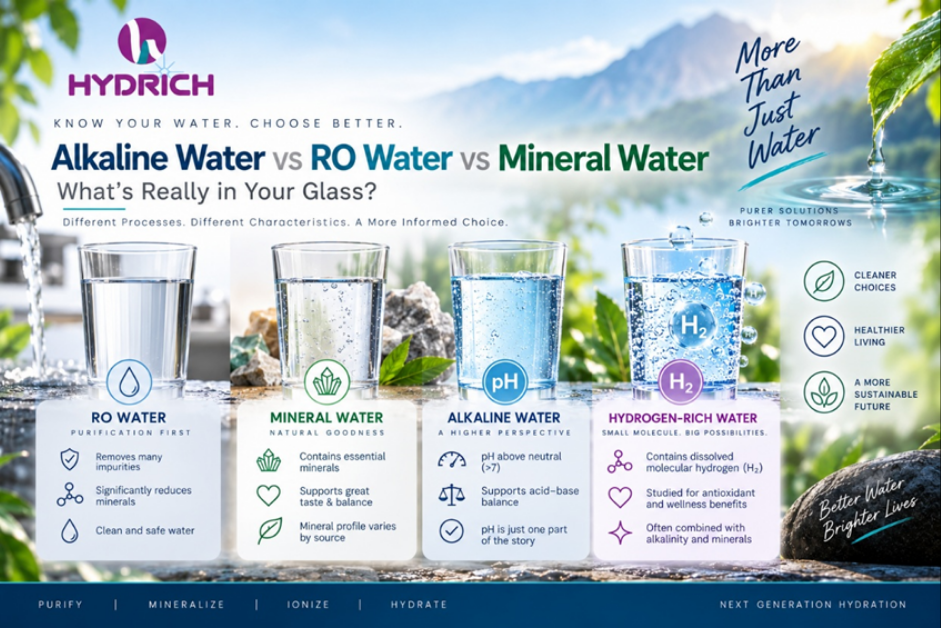
Alkaline Water vs RO Water vs Mineral Water
What’s Really in Your Glass?
All drinking water may look the same. But what happens before it reaches your glass can be very different.
Water is something we consume every single day, yet very few of us stop to ask a simple question:
“What kind of water am I actually drinking?”
RO water, mineral water, alkaline water and hydrogen-rich water are terms we frequently see today. While they are often used interchangeably, they describe different characteristics and treatment approaches.
Understanding these differences can help you make a more informed choice—not based on trends or marketing claims, but on what the water actually contains and how it is produced.
At Hydrich, we believe that better hydration begins with better understanding.
1. What Is RO Water?
RO stands for Reverse Osmosis.
Reverse osmosis is a purification process in which water is passed through a semi-permeable membrane. The system is designed to reduce many dissolved substances and contaminants, depending on the membrane, source-water quality and overall treatment configuration.
This makes RO an important technology for treating water where purification is required.
But there is another side to the process.
Because RO is designed to remove dissolved substances, it can also significantly reduce naturally occurring minerals in the source water.
This means RO is primarily a purification technology.
RO answers an important question:
“How can we purify this water?”
But purification is only one part of the Hydrich approach.
2. What Is Mineral Water?
Mineral water contains dissolved minerals such as calcium, magnesium, potassium and sodium, with the exact mineral profile depending on its source or treatment process.
Minerals influence more than just the composition of water. They can also contribute to its taste and overall drinking experience.
Essential minerals such as calcium, magnesium, potassium and sodium perform established functions within the human body, although drinking water is only one of many dietary sources through which we obtain them.
For this reason, when water has undergone intensive purification, a thoughtfully designed mineralization stage can become an important consideration.
Purification focuses on what needs to be removed.
Mineralization considers what should appropriately remain—or be introduced.
3. What Is Alkaline Water?
The term alkaline water generally refers to water with a pH above neutral.
The pH scale runs from 0 to 14, with pH 7 considered neutral.
However, one of the biggest misconceptions about alkaline water is that:
“The higher the pH, the better the water.”
That is not necessarily the right way to evaluate drinking water.
A pH value tells us something about the acid-base characteristics of water, but it does not by itself tell us the complete story about purity, mineral composition, dissolved hydrogen or overall water quality.
That is why Hydrich does not believe functional water should be reduced to a competition over pH numbers.
There is much more happening inside your glass.
4. Then What Is Hydrogen-Rich Water?
Hydrogen-rich water contains dissolved molecular hydrogen (H₂).
This is different from the hydrogen atoms already present within the H₂O water molecule.
Molecular hydrogen has attracted growing scientific interest, particularly in research involving areas such as oxidative stress, exercise and recovery, cellular signalling and metabolic health.
Research continues to evolve, and hydrogen-rich water should not be presented as a medicine or treatment for disease.
What makes it interesting is that dissolved molecular hydrogen introduces another dimension to the conversation around functional water.
And importantly:
Alkalinity and dissolved hydrogen are not the same thing.
Water can be alkaline without necessarily containing meaningful levels of dissolved molecular hydrogen.
Similarly, hydrogen can be dissolved in water without requiring an extremely high pH.
This distinction is essential when understanding ionized water.
So, Which Water Is Better?
There is no responsible answer based purely on one label.
Rather than asking:
“Is RO better than alkaline water?”
A better question may be:
“What processes has this water gone through before reaching my glass?”
Because these technologies do not necessarily have to compete with one another.
They can perform different roles.
Purification can help prepare the water.
Mineralization can establish an appropriate mineral profile.
Ionization can alter certain electrochemical characteristics of the water and, depending on the technology and operating conditions, generate dissolved molecular hydrogen.
This leads us to the philosophy behind Hydrich.
The Hydrich Approach: More Than Just Purification
Instead of looking at water treatment as a single process, Hydrich approaches it as a carefully connected journey.
PURIFICATION
↓
IONIZATION
↓
ORGANIC MINERALIZATION
↓
ALKALINE, MINERALIZED & HYDROGEN-RICH WATER
↓
FRESH HYDRATION
Each stage has a purpose.
It begins with appropriately treated water, followed by mineralization and then ionization to create the desired characteristics for drinking water.
The objective is not simply to produce water with an impressive pH number.
The objective is to create a more complete hydration experience.
Organic Mineral Technology from South Korea
Mineralization forms an important part of the Hydrich process.
Hydrich incorporates organic mineral technology sourced from South Korea as part of its water mineralization approach.
The process is designed around important minerals such as:
Calcium (Ca)
Magnesium (Mg)
Potassium (K)
Sodium (Na)
Rather than considering purified water as the final destination, Hydrich integrates mineralization as an important stage before ionization.
This creates the mineral foundation required for Hydrich's broader functional-water approach.
Purified Water + Ionization + Organic Minerals
Together, these stages create a different philosophy around drinking water—one that looks beyond purification alone.
Why Minerals Matter in Ionization
Minerals are also relevant to the technical process of water ionization.
Water containing dissolved ionic minerals generally has greater electrical conductivity than highly demineralized water.
This matters because electrolysis-based ionization depends on the movement of ions through water.
The source-water quality, mineral content, flow rate, electrode configuration and other operating conditions can therefore influence the characteristics of the water produced.
This is why simply connecting an ionizer to any source of water does not automatically guarantee the same result.
Good water technology begins with understanding the water itself.
Not Every “Alkaline Water” Is the Same
Two bottles can both carry the words “alkaline water” and still be very different.
One may be naturally alkaline because of its geological mineral composition.
Another may have minerals added.
Another may be produced through electrolysis.
Another may have its pH adjusted through a different treatment method.
That is why consumers should look beyond the words printed prominently on the label.
Consider questions such as:
- How was the water purified?
- What is its mineral composition?
- How was the alkalinity achieved?
- Is molecular hydrogen actually present?
- How fresh is the water?
- How is it stored and delivered?
The more we understand these questions, the easier it becomes to separate meaningful water characteristics from simple marketing terminology.
Freshness Matters—Especially for Hydrogen
Minerals can remain dissolved in water, but molecular hydrogen behaves differently.
Hydrogen is the smallest molecule and can gradually escape from water during storage.
Temperature, container material, sealing, headspace and storage duration can all influence hydrogen retention.
This creates an important consideration:
When hydrogen is part of the objective, freshness matters.
Producing appropriate functional water closer to the point where it is consumed can therefore offer a different experience from water that has undergone extended transportation and storage.
From Centralized Bottling to Water at the Point of Consumption
For decades, our approach to drinking water has largely followed the same model:
Produce → Bottle → Pack → Transport → Store → Distribute → Consume
But modern water technology gives businesses an opportunity to rethink that journey.
Hotels, restaurants, hospitals, corporate offices, institutions and residential communities can explore in-house or on-site water production solutions, depending on their requirements.
This can help reduce unnecessary logistics and, when paired with reusable serving systems such as glass bottles, potentially reduce dependence on conventional single-use packaging.
The conversation then becomes bigger than alkaline water.
It becomes a conversation about:
Water Quality. Technology. Freshness. Sustainability. Experience.
The Future Isn't Just About Drinking More Water
Hydration will always begin with something simple—drinking enough safe water.
But the next generation of consumers is becoming more curious.
They want to know where their water comes from.
They want to understand what has been removed.
They want to know what minerals remain.
They want transparency about how the water is produced.
And increasingly, businesses want hydration solutions that can also support their sustainability and ESG objectives.
At Hydrich, we believe these conversations are shaping the future of drinking water.
Hydrich — Rethinking What Water Can Be
We don't believe water should be judged by one number.
Not only by pH.
Not only by TDS.
Not only by ORP.
And not only by the words written on the bottle.
The bigger picture is how purification, mineral composition, ionization, dissolved hydrogen, freshness and responsible delivery work together.
That is the philosophy behind Hydrich.
PURIFY. IONIZE. MINERALIZE. HYDRATE.
Hydrich — Next Generation Hydration
Better understanding. Better water choices. A more responsible hydration future.
Disclaimer: This article is provided for general educational and informational purposes only. References to alkaline water, minerals and molecular hydrogen should not be interpreted as medical advice or as claims to diagnose, prevent, treat or cure any disease. Research into molecular hydrogen and hydrogen-rich water continues to develop.
